

Cycle card
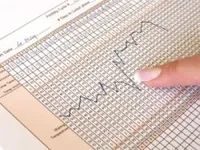
What is a cycle card? How do you use it? How can you identify fertile and infertile days? How can it be used for the early diagnosis of abnormalities in the menstrual cycle?
In the menstrual cycle of a healthy woman there is a key moment – the climax of the cycle – ovulation. This allows the cycle to be divided into two phases: the pre-ovulatory (follicular) phase, during which ovarian follicles containing egg cells grow and mature, and the post-ovulatory (luteal) phase, in which only the remnant of the ruptured follicle, the corpus luteum, remains.
Different hormones dominate in the different phases of the menstrual cycle, and each of them has specific functions. The basic hormones that determine the fertility cycle are those secreted by the pituitary gland – follicle-stimulating hormone (FSH) and luteinizing hormone (LH) – and those produced by the ovaries: estrogens and progesterone.
Each of these hormones plays a distinct role in the cycle, yet they stimulate one another through feedback mechanisms and complement each other’s actions. A proper balance between the individual hormones and optimal levels of each of them ensures the correct functioning not only of the female reproductive system but also of a woman’s overall health. The presence and activity of these key hormones in the bloodstream are reflected in so-called biomarkers – observable, perceptible, and measurable natural biological signs of your body.
What is a cycle observation card?
A cycle observation card is a tool used to record observed biomarkers, making their analysis and interpretation easier.
During your menstrual cycle, these natural physiological signs change along with changing hormone levels:
- In the pre-ovulatory phase, dominated by estrogens, you may observe the appearance and gradual intensification of fertility signs. Changes in the cervix (softening and opening) and in the cervical mucus it produces (thinning and becoming more fluid) are meant to facilitate the survival and transport of sperm from the vagina to the uterus and further into the fallopian tubes.
- In the post-ovulatory phase, dominated by progesterone, you may notice a rapid decline and disappearance of fertility signs (drying up and disappearance of cervical mucus, firming and closing of the cervix). After ovulation, the ruptured Graafian follicle forms the corpus luteum, whose activity is reflected in an increase in basal body temperature (BBT).
After observing several cycle cards, you can obtain a complete picture of your individual menstrual cycle, hormonal balance, and fertility status. However, to interpret these observations correctly, knowledge of the physiological changes occurring in the different phases of the female cycle and the rules for their interpretation is essential.
Read more:
A cycle observation card can take various forms:
- a paper card, with a day scale and space to record data or attach appropriate stickers;
- an electronic card, graphically displaying data entered via a form on a website;
- a mobile card (so-called cycle trackers), presenting data entered through a website or a smartphone app;
- and even… various types of bracelets on which beads representing the different phases of the cycle are strung.
What data are recorded on a cycle card?
A cycle observation card should contain information about the length of the menstrual cycle, i.e., the date it begins (the first day of menstruation) and the date it ends (the day before the next menstruation). A card used in the sympto-thermal method should allow you to record all possible biological and physiological signs.
Daily changes in biomarkers:
- basal body temperature (BBT) measurements (time of measurement, value, and any factors that may have affected the reading);
- cervical mucus (stretchiness, sensations, appearance);
- condition of the cervix (degree of firmness, openness, and position).
Additional individual physiological signs:
- ovulation pain,
- ovarian pain,
- breast tenderness,
- headaches,
- increased libido,
- swelling and puffiness,
- changes in appetite,
- drowsiness,
- PMS symptoms.
Historical statistical data (varying by method or school):
- the length of your shortest menstrual cycle;
- the earliest day of the BBT rise or the Peak Day;
- your individual length of the luteal phase (post-ovulatory or high-temperature phase) or the Post-Peak Phase;
- your individual length of the cervical mucus phase.
What does a cycle card look like?
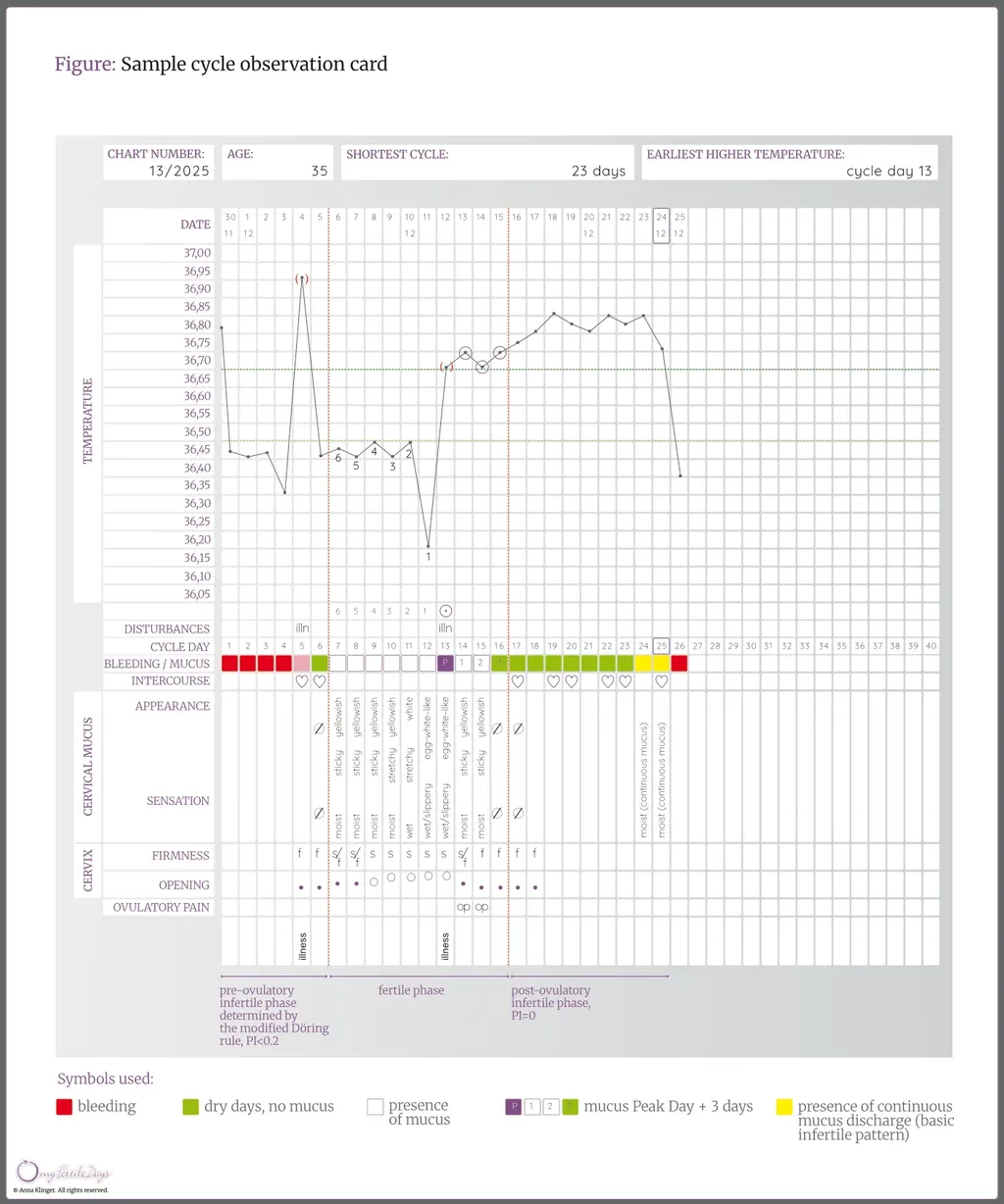
Each cycle observation card used in the sympto-thermal method should include:
- The date the cycle begins, a division into individual days, and information on the cycle number and its length.
- A user data section containing historical data and statistics of menstrual cycles, as well as information on age, weight, and the user’s experience (number of completed cards).
- A section for recording intercourse on particular days of the cycle. It is important to mark the days when intercourse occurred, especially at the transition between phases (important when postponing pregnancy) and during the fertile phase (particularly important when trying to conceive).
- A temperature chart based on daily measurements. Shortly after ovulation, the temperature level rises slightly (by at least 0.2 °C) and then drops again around the time of the next menstruation. Each user sets her own fixed time for taking the temperature; small deviations are allowed (45 minutes earlier or later). Remember to mark any temperatures disturbed by fever or by going to bed later than usual.
- An individual pattern of changes in cervical mucus and the cervix, obtained from daily observations. As estrogen levels in the blood rise, cervical mucus begins to appear at the vaginal opening and the cervix starts to soften and open. Cervical mucus reaches its most fertile characteristics (stretchy, watery, clear, giving a sensation of wetness and slipperiness) at the peak of estrogen secretion preceding ovulation. After ovulation, the cervix becomes firm and closed, and the mucus disappears. In every woman, the development of mucus signs and cervical opening and softening is individual; therefore, it is essential to learn your own fertility rhythm and the specific course of your menstrual cycle.
- Additional notes, which you can enter daily, including other physiological symptoms (e.g., ovulation pain, breast tenderness, migraines), information about your well-being (irritability, drowsiness, or, conversely, high energy), and details about medications, supplements, therapies, tests, or examinations.
What does a standard, normal cycle look like?
Contrary to popular belief, a normal cycle does not have to be 28 days long, nor does it have to be perfectly regular. Differences of even 7-10 days in cycle length can still fall within the normal range. Unfortunately, relying solely on cycle length and regularity is not enough to determine whether a cycle is truly normal. More can be learned by analyzing the following parameters:
- On the temperature chart of the whole cycle, you can distinguish two phases: a low-temperature phase and a high-temperature phase. A biphasic cycle confirms ovulation in about 99% of cases.
- The high-temperature phase has a normal length, i.e., at least 10 days. A shorter phase may suggest progesterone deficiency and problems with maintaining early pregnancy. The post-ovulatory phase usually lasts 11-16 days, with an average of about 14 days.
- The period of cervical mucus up to and including the Peak Day lasts at least 6 days. A scant mucus pattern may be a cause of reduced fertility. On the other hand, discharge present throughout the entire cycle (which is not fertile mucus but vaginal discharge) may result from improper hygiene, irritation, or infection and should be diagnosed and treated.
- There is no spotting before menstruation, no prolonged spotting after menstruation, and no spotting or bleeding during the cycle. Intermenstrual bleeding in a woman of reproductive age, i.e., bleeding not preceded by at least a 3-day high-temperature phase, should be consulted with a doctor.
What is the purpose of keeping cycle observation cards?
- To assess fertility, i.e., to check whether ovulation occurs in the cycle, whether the cycle is biphasic, and whether the luteal phase has an adequate length.
- To diagnose irregularities and anomalies in the menstrual cycle that may have a pathological background and therefore require medical consultation and detailed examinations, such as intermenstrual bleeding, excessive prolongation of the pre-ovulatory phase, shortening of the luteal phase, scant cervical mucus, too short a mucus phase, the presence of continuous discharge, lack of ovulation, abnormally low or high basal body temperature (BBT), prolonged bleeding, or abnormal spotting.
- To precisely determine the fertile phase and the infertile phases, and thus to adapt sexual intercourse to current family-planning and reproductive intentions.
- To monitor the return or decline of fertility during special periods in a woman’s life, such as the postpartum period and the premenopausal years.
- To learn one’s individual fertility rhythm.
- To determine the best time to try to conceive. By keeping a cycle card, you can identify the days closest to ovulation without using ovulation tests or ultrasound cycle monitoring. The following ovulation indicators have been identified: the Peak Day of cervical mucus, the first day of dryness after fertile mucus, a one-day temperature dip just before the rise to the higher level, and the first day of higher temperatures.
- To monitor the effects of treatment or therapy and their influence on individual biomarkers in the natural menstrual cycle.
Cycle observation cards are an excellent tool for the preliminary diagnosis of disorders affecting women’s reproductive health. They allow for the early detection of abnormalities, help schedule examinations and therapies according to the individual course of the cycle, and enable ongoing monitoring of treatment outcomes. Their main function is to provide information about a woman’s current fertility status and to precisely determine the phase of the cycle she is in on any given day.
A cycle card with extended cervical mucus observations is also used in the so-called Creighton Model, which forms the basis of infertility diagnostics in NaProTechnology.
This simple tool, with such a wide range of applications, has recently been gaining popularity. I am personally pleased that women in the premenopausal period are also becoming interested in it – it shows that we want to care for ourselves and for the intimate aspects of our lives at every age. Keep it up!