

Infertility? What next?

What should you do if, despite trying, you are having difficulty conceiving or suspect infertility?
What is infertility?
According to current scientific and medical knowledge, infertility is diagnosed when a couple is unable to achieve pregnancy after 12 months of regular sexual intercourse without using any contraceptive methods. However, it is advisable to seek initial medical consultation after 6 months of unsuccessful, well-timed intercourse during the fertile phase of the cycle.
Fertility problems also include situations in which a pregnancy cannot be carried to a stage at which the baby could survive outside the mother’s body. This concerns preterm births, recurrent miscarriages, and ectopic pregnancies.
What can be the causes of infertility?
Among the factors responsible for reduced human fertility, the following can be distinguished:
- Anatomical abnormalities of the reproductive organs – underdevelopment, structural defects of the reproductive system, various tumors, past or present inflammations, previous surgical procedures, and the consequences of radiotherapy.
- Disorders of general health – ovarian, tubal, or uterine infertility caused by hormonal imbalances (often resulting from long-term use of hormonal contraception), immunological infertility, and infertility of psychogenic origin.
- Environment and lifestyle – excessive workload, stress, and disruption of the biological rhythm (e.g., shift work) can lead to menstrual disorders in women and to decreased sperm production and poorer semen parameters in men. Diet plays a crucial role in fertility; eating disorders such as anorexia or bulimia may even result in the cessation of menstruation and lack of ovulation. Medications, stimulants such as cigarettes, alcohol, drugs, excessive coffee consumption, and exposure to toxic substances are also significant factors.
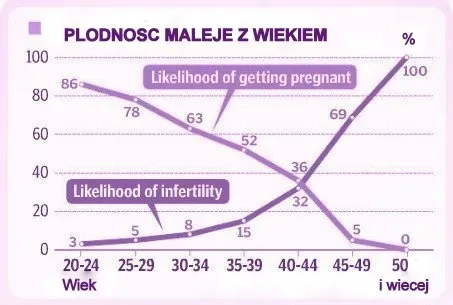
An important factor that increases difficulties in conceiving is the age of both the woman and the man, as well as the tendency to postpone pregnancy to a more “convenient” stage of life. This “convenient moment” is usually associated with completing education, having stable employment, and securing adequate housing, and in recent years it often falls around the age of 30. Let us take a look at how fertility changes with age:
What are the symptoms of infertility? How can you tell that something is wrong?
Couples who use Natural Family Planning (NFP) methods, that is, who observe fertility indicators in the woman’s menstrual cycle, should not have difficulty recognizing a problem. At first glance, basic differences between a fertile and an infertile cycle can be seen:
- A normal, fertile cycle should be biphasic, meaning it has a pre-ovulatory phase with lower temperatures and a post-ovulatory phase with higher temperatures. A single-phase cycle in a woman of reproductive age is associated with ovulation disorders, which may be a cause of difficulties in conceiving.
- A key factor is the proper length of the high-temperature phase, the so-called luteal phase, which is linked to the function of the corpus luteum that supports early pregnancy. A normal luteal phase should last at least 10 days (usually 11–16 days). If it is shorter, there may be a risk of infertility due to luteal phase deficiency (too low a level of progesterone). Insufficient progesterone production is also a common cause of recurrent miscarriages.
- The correct phase of cervical mucus secretion is equally important, as fertile-type mucus ensures sperm survival, nourishment, and transport in the female reproductive tract. A too-short mucus phase, the presence only of low-fertility-type mucus, or a complete absence of cervical mucus may be a significant cause of fertility problems.
Attention should also be paid to the quality of the genetic material that each parent passes on to the child. The quality of reproductive cells can be improved primarily through proper nutrition and a healthy lifestyle, including the elimination of harmful factors and substances.
What tests can help confirm that there is a problem?
To confirm the presence of fertility problems, it is necessary to consult a doctor and perform basic hormone tests: prolactin level, the FSH/LH ratio around ovulation, progesterone level in the post-ovulatory phase, and thyroid hormones. It is important that the timing of these tests be adjusted to the individual course of the woman’s menstrual cycle.
Read more: Reference ranges for tests used when planning pregnancy, diagnosing fertility problems, and treating infertility (available after logging in).
The most commonly recommended imaging studies in gynecological and obstetric diagnostics are:
- Ultrasound (USG) – a non-invasive and accurate assessment of organ structures (uterus, ovaries, fallopian tubes, endometrium), indispensable in monitoring the menstrual cycle. Contrast-enhanced ultrasound, Doppler studies to assess blood flow, and three-dimensional ultrasound can also be used.
- Magnetic Resonance Imaging (MRI) – characterized by very high sensitivity, accuracy, and non-invasiveness; it facilitates the detection of all types of anomalies and the differentiation between benign and malignant lesions (some cancers can be detected already at a preclinical stage). MRI is also used to diagnose endometriosis and abnormalities in the structure of the reproductive organs. Contrast-enhanced MRI is possible.
- Hysterosalpingography (HSG) – allows visualization of the uterus and fallopian tubes after contrast medium is introduced directly into the uterine cavity and enables assessment of the flow of the contrast through different sections of the reproductive tract. HSG is usually used to evaluate tubal patency, diagnose abnormal uterine bleeding, and detect abnormalities of the endometrium. The examination should be performed within the first 10 days of the cycle to rule out pregnancy (and the risk of harming an embryo) and so that the endometrium does not obscure small pathological changes.
- Computed Tomography (CT) – not a non-invasive test due to the use of X-ray radiation at doses higher than in standard radiography. It can be performed during the first 10 days of the cycle to avoid exposing a possible embryo to harmful radiation. CT enables precise assessment of the extent of genital tract tumors and distant metastases, and helps differentiate and localize ovarian lesions. However, it does not allow for detailed visualization of the uterine structure and therefore is not used to evaluate the endometrium.
Read more: How to determine the causes of difficulties in conceiving?
How can fertility be strengthened?
There are many effective ways to naturally support fertility in both women and men. Proper nutrition for prospective parents, along with the use of vitamin and mineral supplements formulated specifically for them, plays an important role. For men, selenium, zinc, L‑carnitine, and vitamins C, E, B6, and A are particularly important, while women benefit from magnesium, iron, L‑arginine, zinc, selenium, folic acid, and vitamins C, E, B6, and B12.
Read more on the blog: Diet for future parents
Attention should also be paid to proper hygiene habits and a healthy lifestyle, limiting stimulants (for example, smoking reduces the number of healthy, motile sperm in men and lowers egg quality in women), using methods that help cope with stress more easily, eliminating harmful environmental factors, and getting adequate sleep. It is also important to be aware that the use of popular lubricants (intimate moisturizing gels) is not recommended, as they may reduce sperm motility.
How can infertility be treated?
Standard methods of treating infertility focus on:
- Pharmacological treatment affecting the hypothalamic–pituitary–ovarian/testicular axis, as well as the treatment of accompanying diseases and anti-inflammatory therapy.
- Surgical treatment aimed at removing the direct causes of infertility related to anatomical abnormalities of the female and male reproductive systems.
- Dietary treatment and supplementation with vitamins and minerals.
Non-standard methods such as physiotherapy, psychotherapy, bioenergetic therapy, and others.
All these methods can be considered genuine therapies insofar as, after resolving the problem underlying infertility, the couple can conceive a child through normal, unassisted sexual intercourse.
Thanks to advances in biology and medicine, many conditions can now be treated. However, this progress is also being used today for purposes other than healing – namely, to control the process of transmitting life and even to “produce” a child as a product made to order (as in assisted reproductive technologies such as in vitro fertilization and ICSI).
It should be remembered that in vitro fertilization is not a therapeutic procedure, because implanting an embryo created outside the woman’s body does not cure the inability of her or her husband/partner to conceive a child naturally. After the IVF procedure, the woman remains just as infertile as before; the underlying problems remain unresolved, untreated, and sometimes even undiagnosed.
It is worth mentioning here a more comprehensive approach to infertility, known as NaProTechnology (Natural Procreative Technology). It is based on the assumption that infertility is not a disease in itself but rather a symptom of disorders or abnormalities present in the woman’s or man’s body. Identifying these problems makes it possible to undertake effective treatment (pharmacological, hormonal, laser, or surgical) targeted at the true cause.
Not all types of infertility can be resolved using NaProTechnology, but its effectiveness is high, and, most importantly, it can lead to a lasting improvement in the health of both the woman and the man.
Czytaj więcej: Naprotechnologia
What should you do when you have reduced fertility or infertility?
- Observe the biological markers of fertility (cervical mucus, changes in the cervix, changes in basal body temperature) throughout your menstrual cycle in order to monitor your fertility and identify any possible irregularities or abnormalities.
- Consult a physician and undergo basic hormonal tests and, if necessary, other examinations such as ultrasound, laparoscopy, etc.
- Treatment should be targeted at the cause of infertility and tailored to your individual menstrual cycle. This type of approach is offered by physicians who work with cycle observation cards using the Creighton Model, applied in NaProTechnology.
- As a result of an effective diagnostic and therapeutic process for both the man and the woman, an improvement in the health of both partners/spouses should occur, which may make it possible to conceive a child without any medical intervention.
- If, however, the treatment process proves unsuccessful, it is worth seeking psychological and spiritual support, which can help you come to terms with infertility and perhaps direct your readiness for parenthood toward adopting a child who dreams of having parents and may be waiting just for you.