

The 10 most common mistakes in natural family planning (NFP)

It must be said that the Sympto-Thermal Method, despite its very high effectiveness, is quite complex and may cause many difficulties for the user. Let us therefore take a closer look at the issues that most often raise doubts.
Errors in assessing and recording fertility signs
1. Averaging and ignoring individual observations of cervical mucus and the sensations associated with it.
Cervical mucus is a natural secretion that appears in the cycle together with an appropriate level of estrogen in the blood. The higher the estrogen level, the more elastic, stretchy, and even fluid the mucus becomes. After ovulation, when the corpus luteum is formed, estrogen is dominated by progesterone, which causes the cervical mucus to dry up and disappear.
- To correctly determine the phase of the cycle you are currently in, never ignore the appearance of the first signs of mucus, and even more so the observation of more fertile-type mucus: stretchy, clear, elastic, fluid, giving a sensation of wetness or slipperiness in the vaginal area – even if such a sign or sensation appears only once during the day.
- Always record the most fertile characteristic of the mucus that you observed or felt on that day. Never average or generalize your observations.
- Also note that the presence of mucus and the intensity with which it is perceived are quite strongly correlated with your level of physical activity during the day.
2. Incorrect identification of the mucus Peak Day.
The so-called Peak Day is one of the most important parameters in NFP, because the correct determination of the different phases of the cycle depends on identifying it properly. Do not confuse it with the day that shows the most fertile characteristics in the entire menstrual cycle. In this context, the “peak” is not related to the maximum intensity of fertility signs. Remember that the Peak Day is the last day on which you can observe or feel at least one of the more fertile-type mucus characteristics. It is a kind of turning point, after which the process of drying up and disappearance of cervical mucus usually begins.
If the Peak Day is not confirmed by a rise in basal body temperature (BBT), another Peak Day may occur later in the same cycle and ovulation may be delayed. In such a situation, it is essential to continue careful, daily observations of all indicators: cervical mucus, the cervix, and BBT.
3. Not knowing how to proceed when there is continuous discharge throughout the cycle.
In some women, discharge is observed throughout the entire menstrual cycle. Usually, this is not cervical mucus but vaginal discharge, caused by an imbalance in the vaginal bacterial flora, an improper diet, or excessive use of hygiene and care products. Whenever in doubt, it is always worth consulting a doctor.
Using the sympto-thermal method in the presence of continuous discharge is possible, but it requires establishing a Basic Infertile Pattern (BIP), that is, identifying and describing the constant features of this discharge. Remember not to rely on general symbolic labels such as: S – stretchy mucus, T – tacky mucus. Instead, record your observations in words, descriptively, until your BIP is clearly established. This will be your personal, constant pattern during infertile phases (e.g. sticky, whitish, giving a sensation of dampness), which changes during the fertile phase. Keep in mind that any deviation from your established BIP marks the beginning of a potentially fertile phase.
4. Failing to record factors that may affect temperature measurements.
In a healthy woman of reproductive age, the basal body temperature (BBT) chart is biphasic, meaning that it shows a level of lower temperatures and a level of higher temperatures. The pivotal moment in the cycle is ovulation, around which this temperature shift occurs. Knowing the full temperature pattern of the cycle is essential for the correct use of the sympto-thermal method.
It is very important to record all factors that could have influenced the temperature reading (e.g., illness with fever, going to bed much later than usual, an all-night event, a different time of measurement, etc.). At the same time, look at your chart objectively – not every disturbance necessarily affects the temperature on a given day.
Getting up at night to a crying baby or to use the bathroom should not disturb the measurement. What matters is having at least one hour of rest in a lying position before taking your temperature. When in doubt, it is always wise to add a note to your chart.
Also pay attention to the conditions under which measurements are taken:
- do not change your thermometer during the menstrual cycle;
- always measure in the same place, and when measuring orally, in the same spot under the tongue (not directly next to the teeth);
- make sure the thermometer tip is not too cold (for example, it is not recommended to store it on a windowsill in winter);
- when using an electronic thermometer, wait for at least the third beep before reading the result.
Errors in the analysis and interpretation of data
5. Not using a cycle observation card.
Ungrouped data is a simple way to make mistakes. An ordinary calendar is not enough. Reliable and systematic completion of cycle charts (BBT charts with marked observations of biological indicators) significantly reduces the risk of error.
Even couples with many years of experience using the sympto-thermal method may make mistakes due to routine, namely: failing to establish the lower temperature level and, as a result, not checking whether the third higher temperature after the Mucus Peak Day meets the requirements of the sympto-thermal method.
6. Interpreting the temperature chart in isolation from other biomarkers.
Remember that when determining the post-ovulatory infertile phase, only the temperature rises that occur after the mucus Peak Day are taken into account, not those before or on the Peak Day itself. All higher temperatures that appear before the Peak Day should be treated as so-called premature temperature rises. They are not directly related to ovulation.
With such a cycle pattern, special attention should be paid to observations of cervical mucus and the cervix, as well as the correct identification of the Mucus Peak Day.
7. Errors in determining the end of the fertile phase.
The third rising temperature after the Mucus Peak Day should be at least 0.2°C higher than the baseline (the lower temperature level). If this is not the case, you should wait for:
- another temperature measurement (the next one should be a high temperature, i.e. above the lower temperature line),
- or the reappearance of fertile signs, another Mucus Peak Day and/or a subsequent rise in BBT lasting at least three days (a shift of ovulation).
It may also be that you are entering a period of major changes, namely premenopause. At this time, increasing deviations from your previous cycle pattern can be observed. The temperature rise may occur more slowly or be much weaker than before.
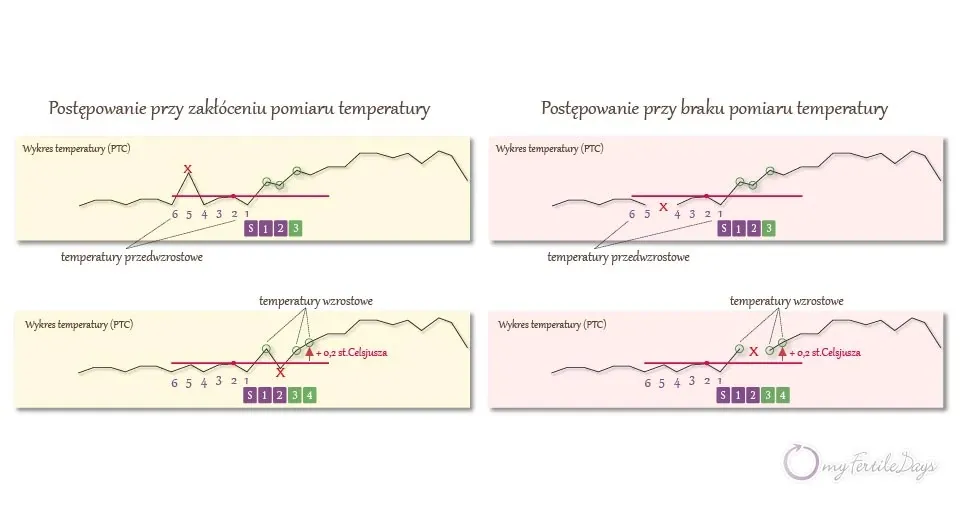
8. Ignoring disturbed temperature readings in the analysis.
You must remember to properly mark, describe, and correctly interpret disturbed or missing temperature measurements. Detailed instructions on how to proceed are presented in the illustration below.
9. Using inappropriate rules to determine the pre-ovulatory infertile phase.
Remember that each rule has its limitations and conditions:
- most rules for determining the pre-ovulatory infertile phase according to Prof. Rötzer’s method are intended for experienced users, i.e., from the 13th observed cycle onward (e.g., the modified Döring Rule, Rötzer’s Rule of the First 6 Days, the Cervix Rule, the Rule of Careful Observation);
- for beginners, i.e., from the 2nd to the 12th observed cycle, the Calculated Rule is recommended;
- regardless of which of the rules intended for you you choose, always pay attention to the first signs of fertility appearing in the current cycle. They are paramount because they relate directly to the present menstrual cycle and your individual hormonal situation.
More details can be found here:
10. Not updating cycle statistics.
Remember that statistical data are subject to change. When starting a new cycle chart, take into account any changes in cycle parameters, in particular: a change in the earliest temperature rise, a change in the length of the shortest cycle observed so far, or a shortening of the period of cervical mucus presence in the cycle. Each of these changes requires updating the rules you use to determine the pre-ovulatory infertile phase.