

The due date – when your baby will be born

How can the age of pregnancy and the expected date of delivery be calculated?
What is the difference between the baby’s age and the gestational age?
A baby’s age is counted from the moment of conception – that is, from the fusion of the female and male reproductive cells. At fertilization, the newly formed life receives a complete and unchangeable genetic makeup (DNA code) that will remain the same until death and determines all individual characteristics (such as eye, skin, and hair color, height, and predispositions to genetic or inherited diseases). After fertilization, the zygote begins a week‑long journey through the fallopian tube toward the uterine cavity, where, after about seven days, it reaches the blastocyst stage and begins the process of implantation in the uterine lining (endometrium).
And now a little confusion – several perspectives on when pregnancy actually begins…
- Obstetricians, midwives, and specialists performing prenatal ultrasound examinations, in the absence of more precise data, usually count pregnancy from the first day of the last menstrual period (LMP). This means that when a woman misses her period and learns she is pregnant, she is already considered to be 4-5 weeks pregnant, even though the embryo itself is only about 2-3 weeks old. According to this method of calculation, pregnancy lasts 280 days, or 40 weeks – this is the so-called menstrual (gestational) age of pregnancy [1].
- Embryology, medicine, and related sciences define the beginning of pregnancy as the moment of conception, that is, fertilization, which occurs shortly after ovulation (within about 12 hours). From fertilization onward, the development of a completely new organism begins. On this basis, human pregnancy is considered to last on average 266 days from conception, or 38 weeks – this is the so-called fertilization age or ovulatory age [2].
- Other viewpoints claim that pregnancy begins only at the moment of implantation in the uterus, that is, when the blastocyst establishes a permanent connection with the uterine lining. Unfortunately, this definition is sometimes used and misused by manufacturers of hormonal contraceptives and so-called emergency contraception, as it allows for harmful effects on the endometrium that prevent the human embryo from implanting.
Why is it so important to determine the due date accurately?
An incorrect estimation of the expected due date may lead to a miscalculation of gestational age and, consequently, to an inaccurate assessment of the baby’s development on ultrasound (for example, a mistaken diagnosis of intrauterine growth restriction).
An incorrectly determined due date can also cause significant stress if labor begins earlier than expected or does not start at the anticipated time, which may result in premature induction of labor or a cesarean section. On the other hand, a post-term pregnancy may pose risks to the baby due to placental insufficiency and reduced oxygen supply.
Methods for determining the estimated due date (EDD)
- Naegele’s Rule is the method most commonly used by physicians, mainly because patients often do not have more precise data. It is based on the first day of the last menstrual period and assumes that the woman does not know the exact day of ovulation. According to this rule, the estimated due date (EDD) is calculated by adding 7 days to the first day of the last menstrual period and then adding 9 months. For women with 28-day cycles, or cycles very close to this length, Naegele’s Rule is fairly accurate; however, it is less reliable for significantly shorter or longer cycles.
- The Prema and Döring Rules are intended for women who observe their fertility signs throughout the menstrual cycle. These methods are based on the date of ovulation determined from the first peri-ovulatory rise in basal body temperature (BBT). Some of the earliest studies on this topic were published as early as 1946 (Tompkins) [3]. Both physicians refined Naegele’s method by proposing the following way to calculate the EDD: take the first day of the peri-ovulatory temperature rise, subtract 7 days, and then add 9 months.
- Professor J. Rötzer’s Rule can also be applied by women who chart their cycles. It differs only slightly from the method described above. Rötzer based his rule on ovulation studies by the Billingses [4], Moore [5], Hilgers [6], and Cortesi and Gnodt, who all concluded that ovulation (and thus fertilization) may occur from 3 days before to 3 days after the so-called mucus peak, most often on the peak day itself. Therefore, taking the mucus peak day as the day of conception, one subtracts 7 days and then adds 9 months to obtain the estimated due date.
- Auxiliary methods, which are of lesser importance for precise dating of pregnancy, include calculations based on the first perception of fetal movements (in a first pregnancy around the end of the 20th week, and in subsequent pregnancies around the end of the 18th week) and on the height of the uterine fundus – the upper part of the uterus that gradually rises toward the navel. As reference points: at the end of the 20th week it is 2-3 fingerbreadths below the navel; at the end of the 24th week it is at the level of the navel; at the end of the 28th week, 2-3 fingerbreadths above the navel; at the end of the 32nd week, midway between the navel and the lower end of the sternum; by the end of the 36th week it reaches the costal arches; and in the first days of the 37th week it begins to descend, so that by the end of the 40th week (according to the last menstrual period) it is 1-2 fingerbreadths below the costal arches.
Cases of premature labor induction are still encountered when a baby is not born on the expected due date. However, more and more physicians are now adopting a more flexible and natural approach, calmly waiting for spontaneous labor to begin while closely monitoring the baby’s condition in the mother’s womb using CTG and ultrasound examinations.
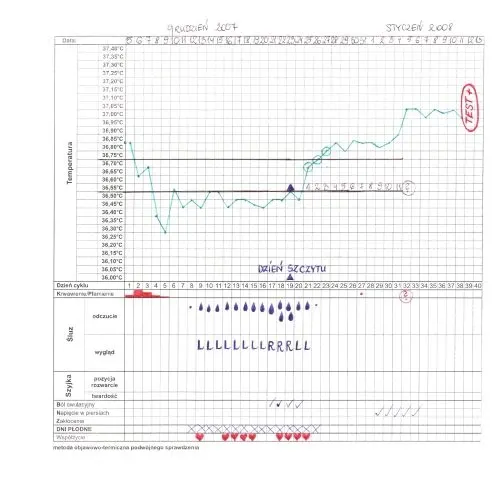
See for yourselves how the estimated due date can vary depending on the method used:
Naegele’s Rule:
5 Dec 2007 (LMP) + 7 days + 9 months = 12 Sept 2008
Prema/Döring Rule:
25 Dec 2007 (BBT rise) − 7 days + 9 months = 18 Sept 2008
Rötzer’s Rule:
23 Dec 2007 (so-called mucus peak day) − 7 days + 9 months = 16 Sept 2008
Based on:
[1] “Embryology“, Prof. Hieronim Bartel, PZWL Medical Publishing, Warsaw, 2010.
[1] “Embryology“, Prof. Hieronim Bartel, PZWL Medical Publishing, Warsaw, 2010, str. 164.
[3] “The duration of gestation. With special reference to the calculation of the date of delivery from basal temperature graphs“, P. Tompkins. American Journal of Obstetrics and Gynecology, No 51, pp. 876–879, 1946.
[4] “Symptoms and hormonal changes accompanying ovulation“, E. Billings and J.J. Billings, The Lancet, pp. 283–294, 1972.
[5] “Ovulation symptoms and avoidance of conception“ W.M. Moore, The Lancet, p. 588, 1972.
[6] “The Peak symptom and estimated time of ovulation“ T.W. Hilgers, G.E. Abraham, D. Cavanagh, Obstetrics and Gynecology, No. 52, pp. 575–582, 1978.