

The rhythm method is already a thing of the past!

Everyone knows it, yet most people still use it 😉.
Do you remember the iconic Maytag wringer washer – a household staple used by American homemakers decades ago? Since those days, the washing‑machine market has changed dramatically. Countless modern models have appeared: machines with hand‑wash or silk settings, washer‑dryer combos, and even those that let you program start and stop times while you’re away from home.
The same has happened with Natural Family Planning (NFP) methods 😀.
Since the development of the rhythm method (the so‑called “marriage calendar”), a great deal has changed in the field of human fertility research. Hundreds of studies have examined ovulation and fluctuations in individual hormone levels throughout the female menstrual cycle, as well as their correlation with the main signs of fertility (cervical mucus, cervical changes, and basal body temperature). These studies were not conducted by Catholic priests, as some people sarcastically suggest, but by scientists from various medical fields, including gynecologists, endocrinologists, and other specialists who work daily to support women’s health.
So what exactly is the “rhythm method”?
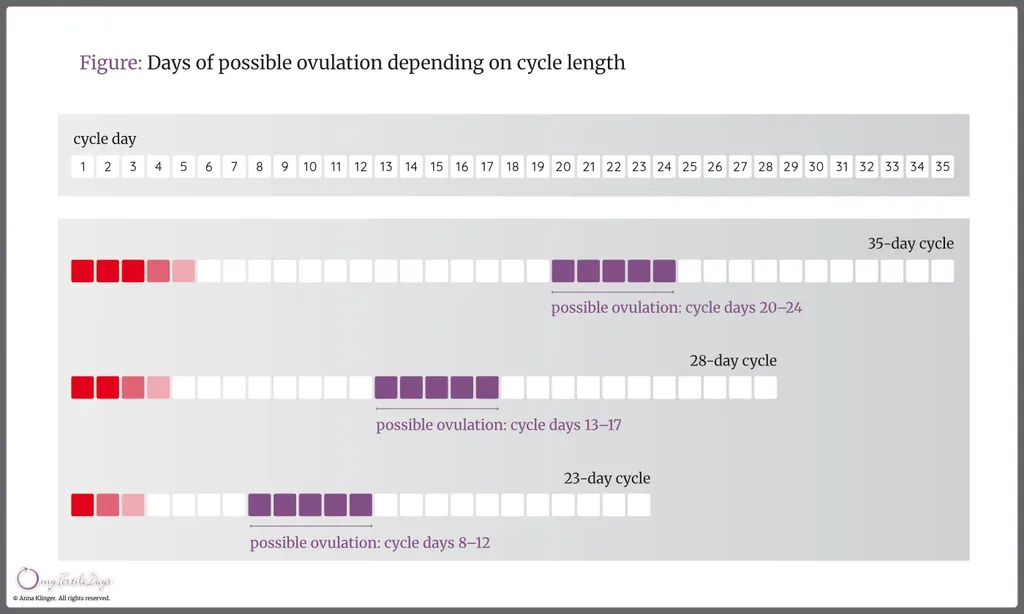
The rhythm method, also known as the calendar method, was developed on the basis of research by H. Knaus from Austria and K. Ogino from Japan and indeed marked a turning point in the study of the female menstrual cycle. These two scientists discovered two very important facts:
- in every woman, the time from ovulation to the onset of the next menstruation is relatively constant (the so-called second, post-ovulatory phase of the cycle);
- in contrast, the time from the first day of menstruation to ovulation can vary from cycle to cycle in the same woman (the so-called first, pre-ovulatory phase of the cycle).
You can see this illustrated in the figure below:
The data needed to apply the rhythm method were based solely on the history of previous menstrual cycle lengths. To determine how many days after menstruation intercourse could take place if pregnancy was to be avoided, the method required subtracting 19 days from the shortest cycle recorded. To determine the period of physiological infertility after ovulation, the rhythm method assumed subtracting 10 days from the longest recorded cycle.
Limitations of the rhythm (calendar) method
In many cases, calculations based on the calendar method are either too restrictive – leaving very few infertile days – or, in other cases, too liberal – treating fertile days as “safe.”
The same problem affects couples who are trying to conceive, because so-called targeted intercourse may then fail to produce the desired result.
A serious illness, significant stress, or hormonal imbalance can disrupt ovulation, prolong the preovulatory phase, or markedly shorten the postovulatory phase. Other situations in which the calendar method should not be used include:
- use of hormonal medications and the associated disturbances of hormonal balance,
- irregular cycles,
- mid-cycle bleeding,
- the postpartum period and breastfeeding,
- the premenopausal period,
- chronic illnesses.
In all of the above situations, however, natural fertility awareness methods can be used – and are even recommended, also for diagnostic purposes (e.g., to monitor treatment or hormonal therapy).
How can fertile days be identified using Natural Family Planning (NFP) methods?
As ovulation approaches, a woman’s estrogen levels – especially estradiol – rise. This can be recognized through the following signs:
- Cervical mucus appears and can be seen on toilet paper during bathroom visits. The closer ovulation is, the more stretchy, clear, and slippery the mucus becomes.
- The cervix becomes softer and slightly opens (which can be detected through self-examination by touch).
- Basal body temperature (BBT) (measured immediately after waking up or after at least one hour of rest) rises by at least 0.2°C around ovulation. A sustained three-day temperature rise indicates that ovulation has already occurred and that the corpus luteum, formed from the ruptured Graafian follicle, has begun to function. The most fertile time is considered to be the day before the temperature rise and the first day of the rise itself.
Because the ovum released during ovulation survives for about 12–24 hours, and sperm can survive in the female reproductive tract for an average of up to 4 days (with research confirming fertilizing capacity for up to 6 days in some cases), modern fertility awareness methods define the fertile window – according to their interpretive rules – as the period from about 6 days before ovulation until 3 days after the day of peak cervical mucus.
And the more difficult question – which days of the cycle are infertile?
At first glance it seems easy, because one could say that they are simply all the days that remain after identifying the fertile days. Yes – but how can we prospectively determine when ovulation will occur in a given cycle?
According to Natural Family Planning (NFP) methods, the following can be considered infertile days:
- all days with no cervical mucus may be regarded as infertile; however, if any mucus appears – even once or only in the evening – the period of potential fertility begins;
- all days when the cervix is hard and closed and no mucus can be detected during examination;
- the evening of the third consecutive day of higher basal body temperature (a rise of at least 0.2°C) marks the beginning of the post-ovulatory phase, that is, the days of natural infertility. Every woman has a unique hormonal balance and level of fertility, and therefore the length of the luteal (post-ovulatory) phase may vary among women – usually from 11 to 16 days. In a given woman, however, it is relatively constant from cycle to cycle. Only in exceptional cases is it shorter than 10 days, which, according to numerous studies, indicates infertility due to corpus luteum insufficiency (too low a level of progesterone).
Learn more: Detailed rules for determining fertile days and periods of natural infertility.
Modern fertility awareness methods make it possible to determine a woman’s current fertility status with great accuracy. They can answer the question: “Are you fertile today?” They are precise because you observe your own individual signs, which appear according to your personal rhythm. They are tailored to you and to your body – you do not have to rely on average cycle lengths or other generalized data from other women, as is the case with the so-called calendar method. For this reason, the effectiveness of fertility awareness methods is very high compared with that of the calendar method.
Of course, one can ignore the fertility signals sent by one’s own body – just as one can still do laundry with an old Maytag wringer washer… But isn’t it worth taking advantage of the latest achievements of science?