
How to determine fertile and infertile days when you are inexperienced in NFP?
Determining fertile and infertile days during the menstrual cycle does not have to be difficult for any woman. However, this skill requires an understanding of the changes that occur in the female body throughout the cycle, as well as consistency and accuracy in carrying out and recording daily observations. Acquiring this ability offers many benefits: it helps a woman better understand her body and emotional changes and, most importantly, provides confidence in many life situations – especially intimate ones.
If this is your first encounter with natural fertility awareness methods, or if you have only recently begun recording self-observations (during your first 1–12 cycle charts), it is recommended to adopt a more conservative approach when determining fertile and infertile periods:
- For women who are still gaining experience in self-observation, infertile days should not be identified at the beginning of the cycle. Instead, only the postovulatory infertile period should be considered.
- The postovulatory infertile period extends from the end of the egg’s lifespan and the formation of the corpus luteum until the next menstrual period. Conception is not possible during this time. It is therefore a phase of absolute (certain) infertility, with a Pearl Index (PI) of 0.
- The postovulatory infertile period is considered to begin on the evening of the third consecutive day of elevated basal body temperature at the higher-temperature level.
 Physiology of fertility
 Maturation of woman
 Avoiding conception
 Pregnancy planning
 Fertility after childbirth
 Fertility problems
 Premenopause and menopause
Rules for women who are inexperienced in self-observation and in recognizing fertility signs are more conservative than those applied to experienced users. These rules assume that a learning period of approximately 12 cycles is needed to become familiar with daily observations, one’s individual cycle pattern, and personal fertility rhythm – and, above all, to correctly apply the principles for determining fertile and infertile days.
If you have just begun observing natural signs of fertility (also known as fertility biomarkers), you should not identify any infertile days at the beginning of the cycle (the preovulatory phase). If you are trying to avoid pregnancy, sexual intercourse should be limited exclusively to the postovulatory infertile phase.
Even after the first observed cycle, you will begin to notice how your fertility signs change and how your basal body temperature chart develops. As you continue observing, you will gradually be able to use your records – particularly information about the length of previous cycles – to interpret your fertility more accurately.
How to determine the infertile days of the preovulatory phase?
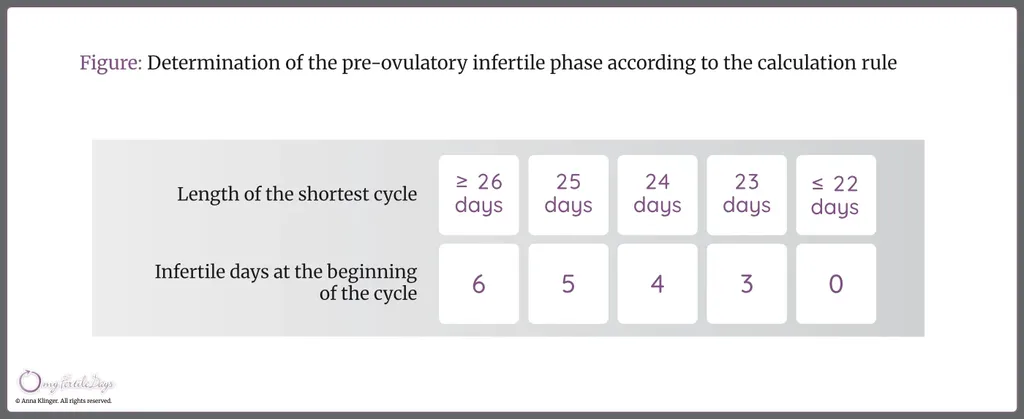
For women who are still inexperienced in fertility observations, the only method used to determine relative infertility at the beginning of the cycle is the calculation (computational) rule.
- If your previously observed cycles were not shorter than 26 days, you may determine the end of the preovulatory infertile phase on the evening of the sixth day of the cycle, provided that no mucus symptoms or permanent changes in secretion were observed on that day.
- If your cycles were shorter than 26 days, subtract 20 days from the length of your shortest cycle. The result indicates the number of infertile days at the beginning of the cycle.
- However, if your menstrual cycles occur every three weeks, no days at the beginning of the cycle should be considered infertile.
How to identify fertile days?
Any day on which you observe cervical mucus, notice a change in your usual secretion, or experience a sensation of moisture or wetness should be considered a day of possible fertility.
It is important to note that not every bleeding is menstrual bleeding. Many women experience mid-cycle bleeding during the periovulatory phase. This is also a fertile time, especially when it is preceded by the presence of cervical mucus and occurs during the low‑temperature phase.
If you have several completed cycle charts, you can easily distinguish mid-cycle bleeding from true menstruation. Bleeding should be considered menstrual only if it is preceded by at least three days of elevated temperatures. If bleeding occurs during the lower-temperature phase, it should be regarded as mid-cycle bleeding, and its last day should be marked as the mucus Peak Day (●) – unless fertile-type mucus appears again afterward.
The fertile period generally includes 6-7 days during the lower-temperature phase and 1-2 days during the higher-temperature phase, provided that cervical mucus is present. Cervical mucus enables sperm to survive in the female reproductive tract until ovulation. On average, sperm remain capable of fertilization for about 4 days, but research has confirmed that survival for up to 6 days is possible under favorable conditions – hence the length of the fertile window.
The most fertile time, optimal for conceiving a child, is the mucus Peak Day and the day immediately following it. On a cycle observation chart, this corresponds to the day before the temperature rise and the first day of elevated temperature.
How to determine the infertile days in the postovulatory phase?
The days of absolute (postovulatory) infertility, can be determined as follows:
- first, identify the mucus Peak Day – the last day on which cervical mucus with the most fertile characteristics is observed;
- then observe the next three basal body temperature measurements, taken immediately after waking up. These temperatures must be higher than the lower-temperature level, which is defined as the highest of the six temperatures preceding the temperature rise. The higher-temperature level is set at 0.2°C above this baseline. If the third consecutive elevated temperature reaches at least the higher-temperature level, the evening of that day marks the beginning of the absolute (physiological) infertile phase.
Once you become experienced in observing your fertility – typically after completing at least 12 cycle charts – you may apply additional rules for determining preovulatory infertility. These include Döring’s rule, Rötzer’s rule, the “W” rule, and rules based on cervical observation. At this stage, you may also begin using the principles of simplified observation, which allow for greater flexibility while maintaining accuracy.
See more: