
Detailed rules for determining the fertile days and infertile days
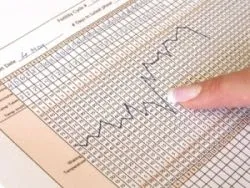
To interpret your cycle observation card correctly – that is, to determine fertile and infertile days – you should follow the sequence of steps below:
- Begin self-observations and daily basal body temperature (BBT) measurements no later than the first day after menstruation begins.
- If you already have experience with self-observation (i.e., you have completed at least 12 cycle cards), you may determine the relative preovulatory infertile days using the modified Döring rule, the Rötzer rule, or the calculation rule. If you are just beginning, you should not determine preovulatory infertility and should identify only the postovulatory infertile phase.
- Identify the peak day of cervical mucus, that is the last day on which stretchy, clear, or wet‑slippery mucus is observed.
- Mark the first higher temperature occurring after the peak of cervical mucus symptoms – it must be higher than the six preceding lower temperatures (number them backwards; the highest of these establishes the so‑called baseline).”
- Continue marking subsequent higher temperatures. If the third higher temperature reaches the higher-temperature level (defined as at least 0.2 °C above the baseline), the evening of that day marks the beginning of absolute postovulatory infertility. If it does not, wait for the fourth temperature, which must remain above the baseline.
In the following sections of this article, the rules for identifying infertile days and determining fertile days will be discussed in detail:
- You can identify the days of pre‑ovulatory (relative) infertility by applying the modified Döring rule, which is based on statistical data from at least 12 previously observed cycles. It relies on the earliest recorded day of the temperature rise (Pearl Index < 0.2).
- Preovulatory (relative) infertility lasts until the appearance of any of the following signs: the sensation of ‘W’, the observation of mucus during internal self‑examination, or a change in the cervix confirmed by self‑examination (Pearl Index = 0.9).
- You can determine the preovulatory infertility phase only if the previous cycle was biphasic.
- For an inexperienced woman without sufficient observation history (fewer than 12 recorded cycles), the preovulatory infertile phase cannot be determined. If adequate data are available, the Rötzer rule or the calculation rule, both based on the length of the shortest observed cycle, may be applied.
- Any rule may be used only after confirming that no current signs of fertility are present.
- The postovulatory (absolute, certain) infertile phase begins on the evening of the third day of elevated temperatures following the mucus peak.
- All days on which any sign of cervical mucus secretion is observed can be considered potentially fertile. The days of maximum fertility are: the so‑called peak mucus day and the day following the peak, as well as the day on which the temperature chart shows the minimal temperature drop just before it rises to the higher‑temperature level, and the first day of higher temperature.
 Physiology of fertility
 Maturation of woman
 Avoiding conception
 Pregnancy planning
 Fertility after childbirth
 Fertility problems
 Premenopause and menopause
Rules for determining infertile days (postponing conception)
For couples wishing to postpone conception, the key task is to identify periods of relative (preovulatory) and absolute (postovulatory) infertility. Over many years of research on female fertility, several rules have been developed to help accurately determine these periods.
Rules for determining preovulatory (relative) infertility
1. The dry day rule is based on observations within the current cycle. The appearance of any cervical mucus always indicates the beginning of the fertile phase, whereas dry days are considered days of natural infertility.
Several important assumptions apply to the dry day rule:
- the appearance of the “W” sensation (careful observation) – characterized by a feeling of pronounced wetness or bubbling in the vagina, even in the absence of visible mucus – marks the beginning of fertility and often precedes visible mucus by a short time;
- a crucial element of this rule is internal observation (at the cervical opening), as mucus may be detected there earlier than on the external genitalia. Internal observation should be performed once or twice daily, while external observation can be done during each visit to the toilet;
- to avoid conception, intercourse is permitted only in the evening, after a full day of observation has confirmed the absence of fertility signs;
- this rule does not apply in cycles where the mucus phase lasts fewer than five days.
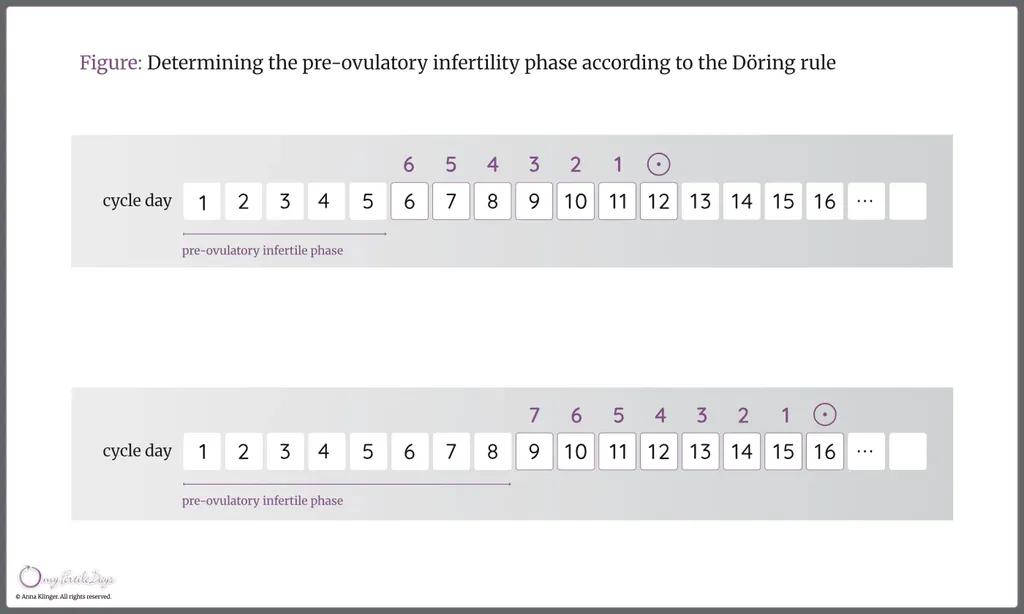
2. The modified Döring rule is used to interpret the temperature chart. This rule is based on statistical data from 12-24 observed cycles. Starting from the earliest recorded temperature rise, count backwards 7 days (if the earliest higher temperature occurred on day 14 or later of the cycle) or 6 days (if the earliest higher temperature occurred on day 13 or earlier). The result marks the last day of the relative infertility phase.
The assumption here is that women who observe a constant presence of less‑fertile‑type mucus during the first phase may disregard this sign within the limits defined by the Döring rule; however, any change in mucus characteristics indicates the beginning of the fertile period. The Pearl Index for the Döring rule is below 0.2.
In the first example, the earliest higher temperature occurred on day 12, which means that the preovulatory infertile phase extends from day 1 to day 5. In the second example, the earliest higher temperature occurred on day 16 of the cycle, so the preovulatory infertile phase extends from day 1 to day 8.
It should be emphasized that, as with all fertility rules, the earlier appearance of any fertility signs – such as the presence of cervical mucus, a change in a previously constant mucus pattern, or softening and opening of the cervix – marks the beginning of a period of possible fertility, regardless of calculated infertile days.
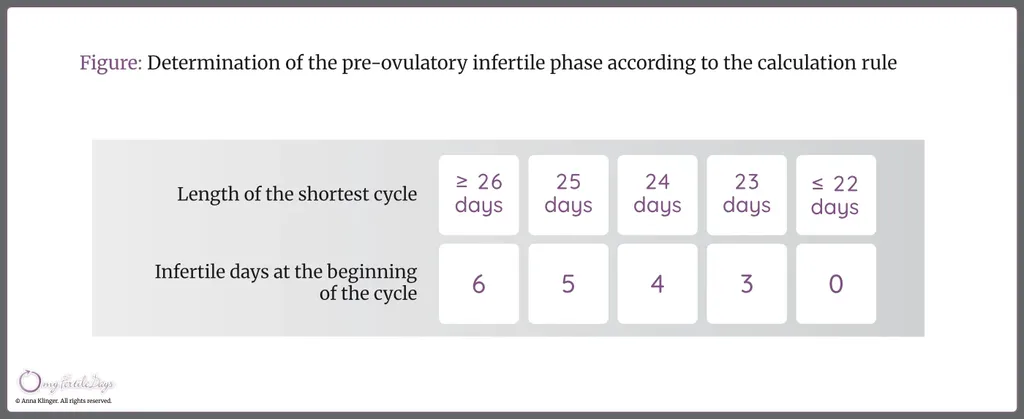
3. The calculation rule is based on research conducted by physicians and scientists specializing in Natural Family Planning (NFP), concerning the shortest of the observed cycles. This research showed the presence of relative infertility during the first six days of the menstrual cycle if a woman’s cycles are 26 days or longer. Depending on the statistical length of the 24 previously observed cycles, the pre‑ovulatory infertility period is as follows:
It should be noted that if the Döring rule indicates a shorter preovulatory infertile phase, that result must always be respected. If any signs of fertility – such as cervical mucus or cervix changes – are observed earlier, this marks the beginning of the fertile period, regardless of calculated infertile days.
- The Rötzer “first six days” rule assumes that a woman may consider the first six days of the cycle as a period of relative infertility only if her cycles are at least 26 days long and no fertility signs are observed during those days. The Pearl Index for this rule is below 0.2.
- The cervical‑mucus rule can be used when a woman chooses to perform cervical self‑examination. According to this method, the pre‑ovulatory infertility period lasts until the last day on which the cervix is observed to be firm and closed. Any change toward opening, softening, or the appearance of mucus is a sign that fertility is beginning. It should be noted that the Pearl Index for this rule is approximately 0.9, indicating lower effectiveness compared to the Döring rule or the Rötzer rule.
Important! Do not determine infertile days at the beginning of the cycle if, in the previous cycle, no phase of higher temperatures was observed (i.e., if the cycle was monophasic).
Rules for determining the beginning of the post‑ovulatory (absolute, certain) infertility phase
- The basic rule of Prof. Josef Rötzer was developed based on long‑term research conducted by him and his institute. It identifies the beginning of the absolute infertility period as the evening of the third day of higher temperatures, provided that:
- all three higher temperatures occur after the peak day of cervical mucus symptoms;
- the last of the three higher temperatures is at or above the level of the higher‑temperature line, meaning at least 0.2 °C above the baseline established by the six preceding lower temperatures;
- if the third temperature does not reach the higher-temperature level, one must wait for a fourth temperature measurement, which does not need to be at the higher‑temperature level but should still be above the baseline.
Note: It is important to mark the three higher temperatures as “certain” (with a circle) only after the day on which the peak mucus symptoms occurred. If the temperature chart begins to rise before the peak day, such measurements should be treated as a premature temperature rise and marked with the ↑ symbol.
- The temperature rule was developed for women who have difficulty observing any mucus symptoms (the “S” sign is not noticeable at all) but who do observe two phases on their basal body temperature chart. According to this rule, the absolute infertility phase begins on the evening of the fourth day of temperature rise above the baseline, provided that the last three temperature measurements are at least at the higher-temperature level.
- According to the Billings method, the infertile period begins on the fourth day after the so‑called peak mucus day and lasts until menstrual bleeding begins, provided that no mucus symptoms are observed.
Rules for determining the fertile period (pregnancy planning)
The observation of any cervical mucus always indicates entry into the fertile period; however, the exact day of ovulation is difficult to determine with absolute precision. There are four indicators that help estimate the timing of ovulation:
- Appearance of the most fertile cervical mucus – stretchy, transparent, and associated with a wet-slippery sensation.
- The first day of reduced mucus quality – indicating the appearance of less fertile mucus immediately after the mucus peak day.
- A one-day temperature dip – a slight drop in basal body temperature occurring just before the rise to the higher-temperature level. This typically appears close to ovulation, especially when preceded by several days of fertile-type mucus.
- The first day of temperature rise – the first elevated morning temperature may be observed only a few hours after ovulation, making this period one of the most fertile.
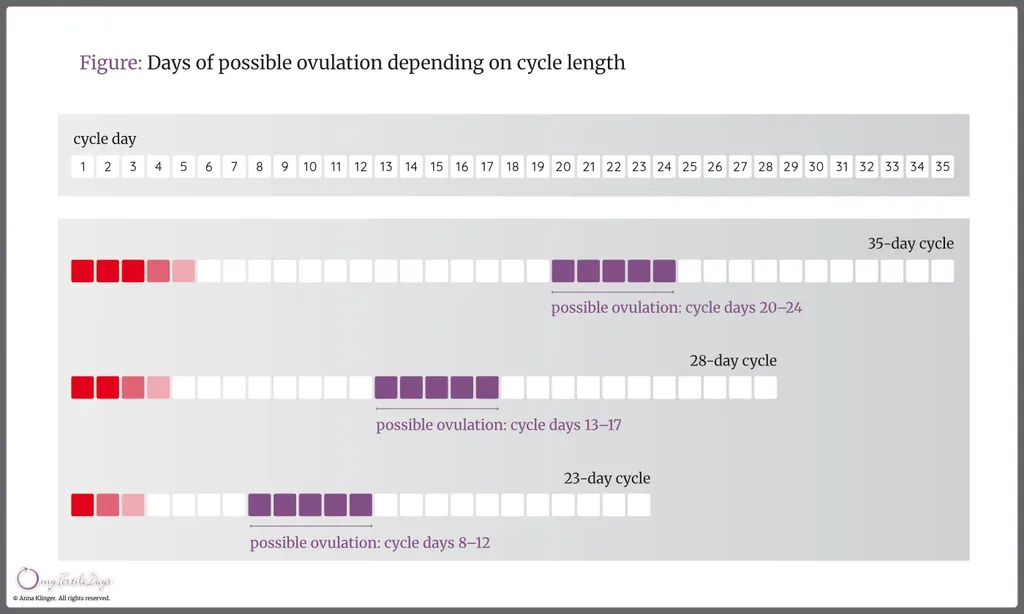
It would be a mistake to assume, as is commonly claimed, that fertile days occur around day 14 of the cycle or mid‑cycle for all women. Ovulation usually takes place between 12 and 16 days before the next menstrual period. The illustration below shows the possible ovulation days depending on the length of the menstrual cycle.
Note 1. It should be remembered that sperm can survive in high-quality cervical mucus for up to six days, whereas the egg remains capable of fertilization for up to 12 hours (or up to 24 hours in the case of the release of two eggs).
Note 2. A cycle can be considered fertile if it is biphasic, meaning that a phase of lower temperatures is followed by a phase of higher temperatures.
Note 3. A higher-temperature phase lasting at least 10 days indicates a fertile cycle. Research confirmed by several fertility experts (e.g., Ober and Döring) shows that shortening the higher-temperature phase to less than 10 days is a sign of infertility.