
The female and male fertility
Fertility is the ability to conceive a new human being – it is the life transfer by joining male and female reproductive cells.
The male fertility, the ability to produce male gametes – sperm, is constant since the end of puberty until death. Female fertility, including the ability to produce female gametes – eggs – is periodic, cyclical, and typically declines around the age of 55. It means that the fertility of couples, men and women, is also periodic, determined by the rhythm of the woman’s fertility.
Awareness of the sperm production mechanism in the male body and the changes in a woman’s body related to her cycle of fertility is basic knowledge, and each mature, fertile person should know it.
In the following sections of this article, some basic issues regarding the fertility of men and women will be discussed:
- The woman’s fertility results from an ovarian (ovulation) reserve possessed by her from birth and cyclical processes that enable her to produce a mature egg and to ensure the proper conditions inside the woman’s body for conception and development of a new life are activated, and they last until menopause;
- Semen production (spermatogenesis), resulting in a sufficient number of mature sperm, takes about 2.5 months. During this time, many factors can affect sperm quality, which may ultimately lead to fertility problems;
- Fertility of the couple is not accidental, but it results directly from the woman’s fertility cycle, and the ability to recognize the signals sent by the woman’s body allows for non-invasive, natural family planning;
- A couple’s fertility depends on three factors simultaneously: the quality of the egg, the quality of the sperm, and the quality of the cervical mucus.
 Physiology of fertility
 Maturation of woman
 Avoiding conception
 Pregnancy planning
 Fertility after childbirth
 Fertility problems
 Premenopause and menopause
The female fertility
A woman’s fertility involves many complex cyclical processes that lead to the periodic production of a mature egg and prepare the body to support its fertilization, development, and the sustenance of new life.
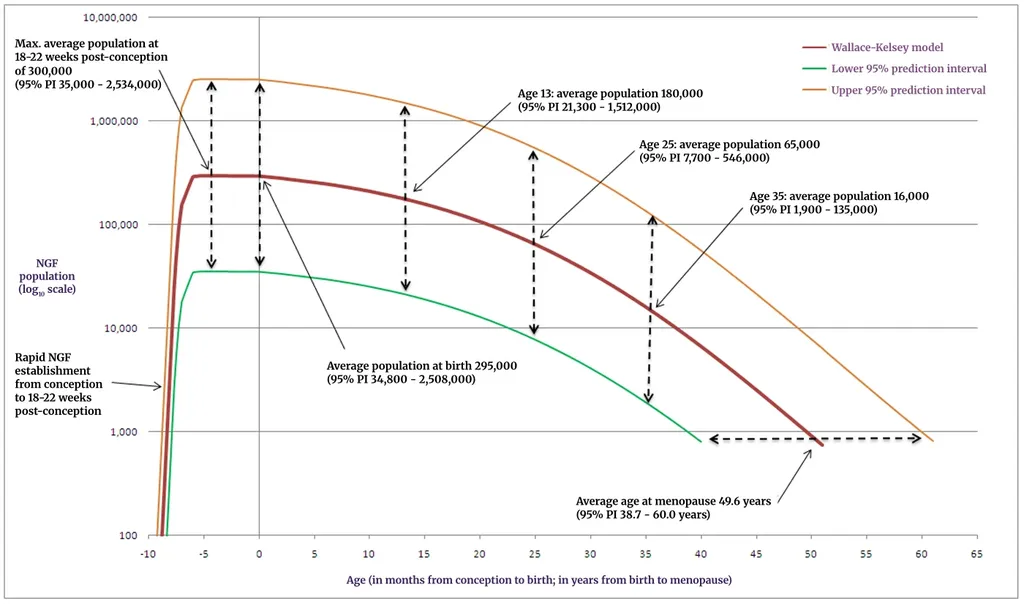
The female reproductive cell – the egg – is released regularly in a mature woman’s ovaries from adolescence until menopause (around age 55). It is important to remember that every woman is born with an ovarian reserve – a number of primary follicles containing immature eggs. According to a recent study [1] conducted by Dr. Hamish Wallace and Dr. Tom Kelsey, at the moment of birth, this reserve amounts to approximately 300,000 follicles and steadily declines with age to fewer than 1,000 before the menopause. The study also highlighted the considerable variation in ovarian reserve among women. In some cases, the reserve included as many as 2,000,000 follicles capable of developing, while in others, it was only around 35,000. According to the model defined in the study and illustrated in the graph below, the ovarian reserve of a 30-year-old woman represents, on average, only 12% of the reserve she had at birth.
Reduced ovarian reserve in the reproductive age can cause problems with fertility, and its determination is very important in the diagnosis of infertility.
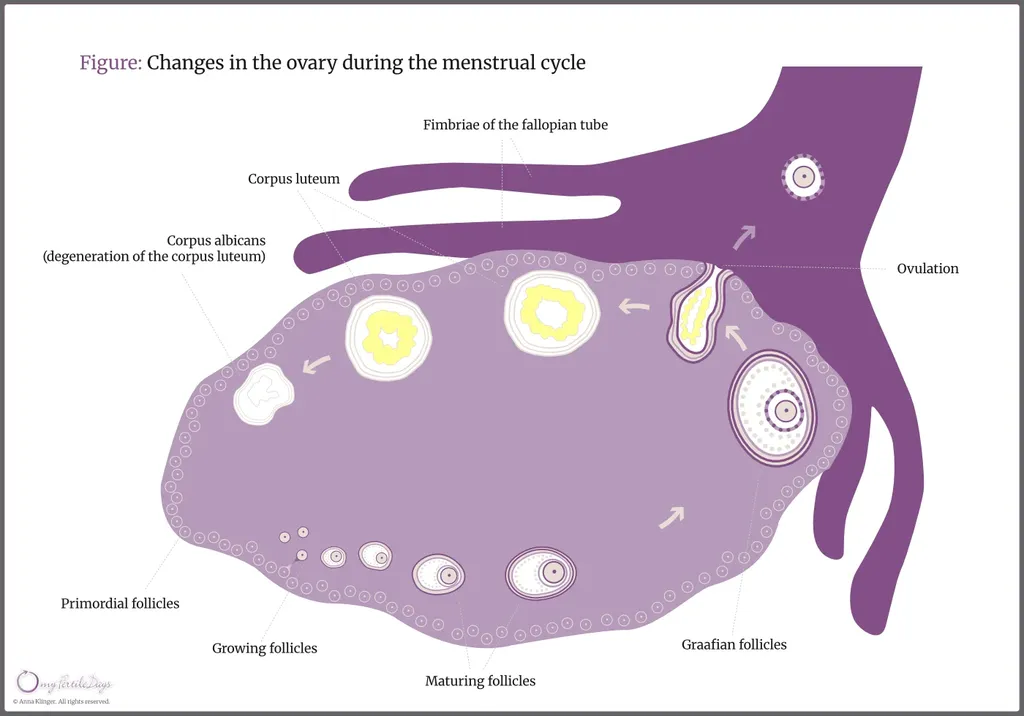
During a woman’s lifetime, only about 400 eggs from her ovarian reserve reach maturity. The onset of sexual maturity marks the beginning of the cyclical process of follicular growth, which continues until menopause. In this process, successive groups of primary follicles containing oocytes develop into growing follicles. In each cycle, one of these follicles (and occasionally more than one) becomes dominant and matures into a Graafian follicle, which releases the egg into the fallopian tube during ovulation. The development of a particular egg begins approximately three months before its release. Between 50 and 300 primary follicles start to grow, but only one (or sometimes more than one) becomes dominant after about 10 weeks. The egg within this follicle matures and is released at ovulation. Although the stimulation of primary follicle growth occurs in every menstrual cycle, the complete process – from the initial signal sent by the brain to ovulation – spans several cycles. As a result, the ovary always contains follicles at various stages of development.
The egg released during ovulation survives for only up to 12 hours (or up to 24 hours in the case of multiple ovulation).
The entire process of follicular growth and egg release is closely linked to a woman’s hormonal cycle, which also prepares a favorable environment for the conception of new life. After ovulation, the hormones secreted inhibit the maturation of other eggs in the same cycle and trigger changes in the woman’s uterus, including the opening of the cervix, the production of cervical mucus, and the growth of the endometrium that was shed during the previous menstruation. All of these processes are designed to provide optimal conditions for sperm transport, egg fertilization, and embryo implantation in the uterus. It is important to note that cervical mucus, whose quality depends on a proper hormonal balance and the overall health of the woman, plays a crucial role in fertilization, and its quality significantly influences the success of this process.
The male fertility
The male reproductive system is described and illustrated in virtually every anatomical atlas, including Wikipedia, so it is unnecessary to repeat that description here. However, it is worth briefly mentioning the process of spermatogenesis – the production of male germ cells, or sperm – and the maturation of sperm capable of fertilization.
Sperm, which contain the genetic material, are produced in the seminiferous tubules of the male testes and then mature in the epididymis. The production and maturation of sperm (spermatogenesis) are stimulated by hormones – follicle-stimulating hormone (FSH) and testosterone – and result in the formation of sperm and seminal fluid, together forming semen. Sperm account for only about 5% of semen, which has a mildly alkaline pH (around 7.2), while the remaining components of semen support and enhance sperm motility. During orgasm, sperm are transported from the epididymis through the vas deferens to the ejaculatory duct and urethra, eventually leaving the male body during ejaculation. The expelled semen is usually milky white, sometimes with a yellowish tinge. Its volume ranges from approximately 2 to 6 ml, and in a healthy man it generally contains at least 500 million sperm. It is normal for semen to contain a small proportion of damaged or non-motile sperm. The production of mature, fertilization-ready sperm takes about 10 weeks. During this period, a variety of factors can affect sperm quality, which may ultimately lead to fertility problems.
What determines the fertility of couples?
As has already been stated, the fertility of the couple is very limited and results directly from the woman’s fertility cycle. The most important, however, is that the period of couple fertility is not accidental – it is very clearly indicated by cyclical changes in the female body which can be easily observed without the use of medical equipment, and the results of these observations can be used to delay conception or determine the best time to conceive a new life – which means natural family planning.
The fertility of a man and a woman is stimulated by specially designed and produced hormones in the human body, and external interference in the hormonal balance may affect human reproduction. The fertility of a couple depends on three factors simultaneously:
- good quality of an egg,
- good quality of sperm,
- good quality of cervical mucus.
It is also important to note significant research findings showing a decline in parameters associated with both female and male fertility, not only due to age, but also as a result of environmental and lifestyle factors. In many cases, when dealing with fertility issues, simply adopting healthier habits and addressing any inflammation or chronic conditions may be enough to overcome the problem.
Read more: