
How to determine the best moment of conceiving?

A woman’s fertile days can be accurately identified by keeping a cycle observation chart.
During the fertile period, the dominant hormones are estrogens. They stimulate the gradual growth of the uterine lining (endometrium) and have a particularly strong effect on receptors in the cervix, prompting the secretion of cervical mucus. As estradiol levels rise, the characteristics of this mucus change – from less fertile forms to highly fertile mucus that provides optimal conditions for sperm survival and transport. Estradiol also causes the cervix to open, which further facilitates the passage of sperm into the uterine cavity and fallopian tubes.
 Physiology of fertility
 Maturation of woman
 Avoiding conception
 Pregnancy planning
 Fertility after childbirth
 Fertility problems
 Premenopause and menopause
During the periovulatory period, cervical mucus secretion reaches its peak and acquires its most fertile characteristics: it becomes clear, transparent, stretchy, and produces a distinct sensation of wetness and slipperiness. After the peak day, the quality of the mucus gradually declines and eventually disappears.
It is important to note that seminal fluid is alkaline, while the vaginal environment is naturally acidic. Without the presence of optimal alkaline cervical mucus, sperm survive only a few hours. Fertile-type cervical mucus creates conditions that allow sperm to survive in the female reproductive tract for up to 5-6 days; therefore, intercourse during this time offers the highest chances of conception for couples planning a pregnancy.
The fertile phase includes:
- approximately 6 days before ovulation, due to the maximum lifespan and fertilizing capacity of sperm;
- up to 2 days after ovulation, due to the limited lifespan of the egg released during ovulation (up to 24 hours, or up to 48 hours in the case of multiple ovulation).
The end of the fertile period is indicated by a sustained rise in basal body temperature to the higher temperature level for three consecutive measurements.
For couples trying to conceive, identifying the most fertile days is particularly important. The appearance of any cervical mucus signals the beginning of fertility; however, the exact day of ovulation cannot be determined with absolute precision.
Four indicators have been identified to help estimate the timing of ovulation:
- The appearance of highly fertile cervical mucus, that is, stretchy, clear, and giving a wet–slippery sensation.
- The first day of the so‑called “drying‑up phase”, that is, the appearance of less fertile‑type mucus immediately after the peak day of cervical mucus symptoms, often corresponds to the day of ovulation, according to hormonal studies conducted by Billings, Brown, and Hilgers.
- b>A one‑day temperature dip just before the rise to the higher temperature level, which sometimes occurs around ovulation when it has been preceded by several days of observing more fertile‑type cervical mucus. Intercourse on the morning of this distinct temperature dip and at the end of the peak mucus phase may occur very close to the moment of ovulation and can favor conception. This temperature dip is likely caused by the high estrogen levels present immediately before ovulation.
- The first day of temperature rise – the first elevated morning temperature may occur only a few hours after ovulation, making this day part of the highly fertile window.
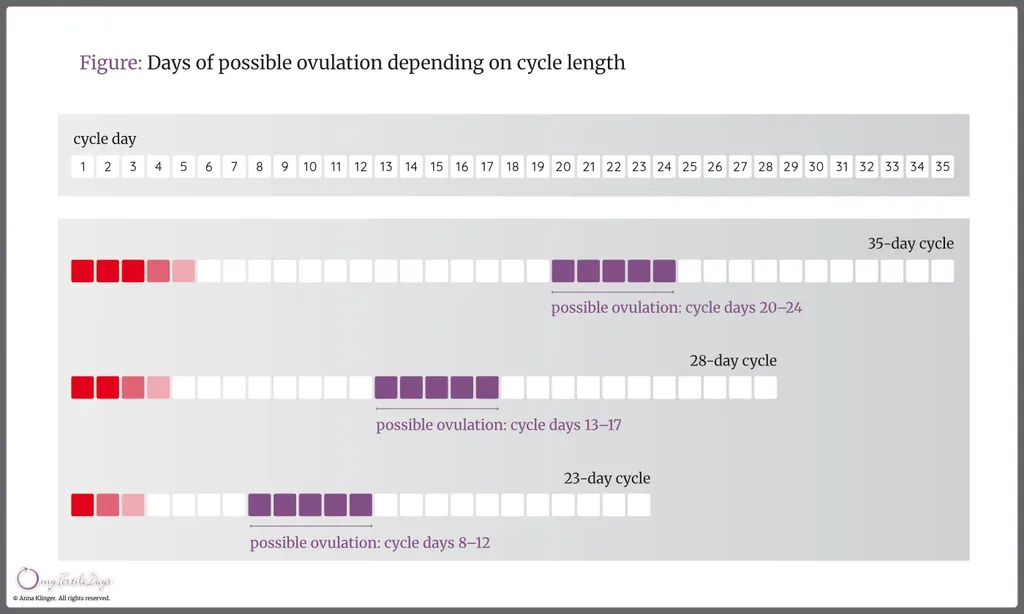
The diagram below illustrates the possible days of ovulation depending on the length of the menstrual cycle.
The key issue in interpreting a Cycle Chart is determining whether a menstrual cycle can be considered fertile. If the cycle is biphasic – that is, a phase of lower temperatures followed by a phase of higher temperatures lasting at least 10 days – it is regarded as normal and potentially fertile. If the higher‑temperature phase lasts fewer than 10 days, this may indicate reduced fertility. It is important to note that such cycles may, over time, return to having a sufficiently long higher‑temperature phase, restoring the possibility of conception. Additionally, luteal phase deficiency can often be effectively managed with appropriate medical treatment.